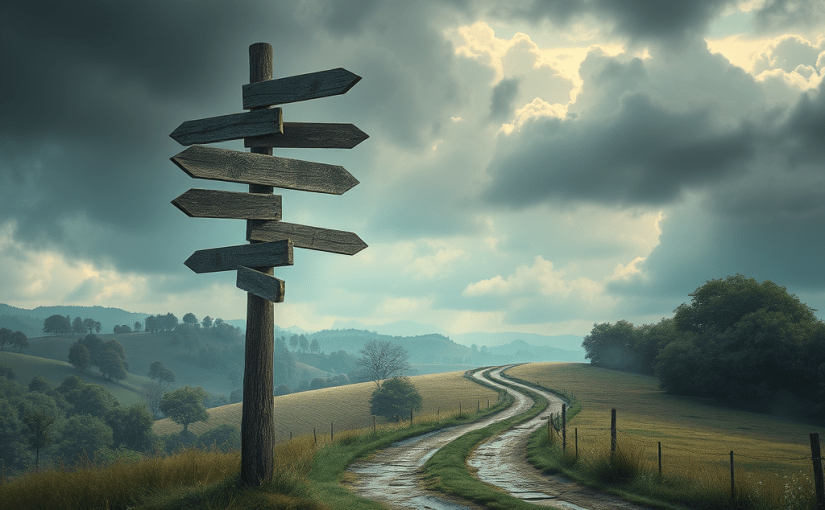
Crossroads

The beginning of 2025 finds my life at a crossroads. I’m very close to finishing my third novel, a project on which I’ve been working for years and desperately want to complete. At the same time, I seem unable to focus on it. My husband was laid off from his job at the end of September, leaving us adrift in a gulf of uncertainty.

Do I sequester myself in some quiet place where I won’t be distracted for a couple of weeks to finish my book? Should I put the book aside for the time being and look for steady nine-to-five work? Or should I try to find more freelance jobs so I can have a flexible schedule and make more money at the same time, allowing me to still work on the novel? If I do this, will I be too tired to work on the book anyway?

Perhaps I should try to bushwhack my own path, combining these options in such a way that I’ll be able to accomplish most of what I want?

I’ve been stuck, waiting for a sign, for some sort of messenger to point the way, getting nothing done in the meantime.

In Western folklore, crossroads often symbolize liminal spaces, places between worlds, middle passages that are neither in one realm nor another. In medieval Europe, the bodies of executed criminals and people who had committed suicide were often buried at crossroads as they were considered a sort of no man’s land, places set apart from the world from which the souls of the dead would be unable to escape.

Lacking a map or any sense of direction, I’ve discovered that exiting a crossroads, where no path is clearly defined, can be almost as difficult for the living.

In many cultures, crossroads are places where demons and spirits appear unexpectedly. In the early 20th century American South, many African Americans believed visiting a crossroads at certain times of day meant encountering the Devil. It brings to mind the frequently covered song, Cross Road Blues, by blues guitar pioneer Robert Johnson, originally released in 1937. According to legend, Johnson, who died mysteriously at age 27, acquired his impressive musical skills after selling his soul to the Devil at a crossroads.

Robert Frost’s famous poem The Road Not Taken, published in 1916, also comes to mind, as crossroads often symbolize indecision, uncertainty, or even regret in literature.

But crossroads can also be places of opportunity. By their nature, they are places where chance meetings are likely to occur, perhaps allowing favorable circumstances to unexpectedly manifest themselves.

Modern psychology says when we find ourselves at a crossroads, unable to decide which direction to take, it often means we are preparing to let go of something to which we are emotionally attached. I often feel this way lately. Whichever direction I choose to go, I’ll be leaving something behind. And because whatever I stand to potentially gain remains undefined, the risk involved in taking any one road seems great.

Robert Frost felt called to take the road “less traveled by,” knowing he’d probably never learn what he might have discovered had he chosen the other path. One of these days, the voice of wisdom will prevail and I’ll know what I should do, too. In the meantime, I’ll be keeping an eye out for the Devil.

ENP

Art is Power

I’ve been thinking about art lately, not only visual art but also literature and music. These things are an important part of my life, not just because I’m a writer but because they make me feel connected to something larger than myself, to other people, to memories I’d forgotten about. Whether I’m listening to music, reading a novel, or looking at a mural, art makes me feel grounded.

Whatever form they might take, we have known for a long time that the arts help foster a sense of community among people by lifting up and celebrating universal human experiences. They give us hope, promote mutual understanding, and can engender feelings of strength and empowerment.

Novels, songs, photographs, and paintings let us know we’re not alone, that there’s a light, however faint, waiting for us someplace in an often too-dark world.

It doesn’t happen often, but there have been times when a painting, photograph, or piece of music has moved me to tears. I once stood in the middle of a gallery at the Addison Gallery of American Art in Andover crying uncontrollably after looking at a photograph by Sally Mann.

It was an image of a young girl, about seven or eight years old, playing outdoors in dress-up clothes, her dirt-smudged cheeks a perfect foil for the string of pearls around her neck. The expression on her face was one of pure ferocity: Try to stop me. I dare you.

The photograph evoked a time in my early life—in the young lives of nearly all women—when I was fearless, bold, when I was in full possession of my own power and could wield it at will for my own sake and enjoyment, without consideration for the way my behavior would be viewed by anyone, especially members of the opposite sex. Try to stop me. I dare you.

The girl in that photo was me, before I was told that it was time I started dressing and and acting a certain way, that I should lose ten pounds, cross my legs, keep my voice down. Until the moment I set eyes on that image, I’d forgotten all about her. In some ways, that photograph gave me back a part of myself that I’d lost.

The arts communicate thoughts and ideas in a way nothing else can, directly from the heart and mind of one person to the heart and mind of another, even across continents and centuries. It’s for this reason that the arts, and creative people themselves, have historically been viewed as threats by the governments of certain countries, especially by autocratic regimes.

In the 1930s, Hitler’s Gestapo arrested any creative person whose work didn’t conform to Nazi ideology, destroying their studios, dismissing them from their jobs, even sending them to concentration camps.

As part of their mission to squash dissent, authoritarian governments continue this practice today. In 2011, artist and filmmaker Ai Weiwei was arrested and jailed by the Chinese government. And in 2021, Cuba’s president, Miguel Diaz-Canel Bermudez, had artists Luis Manuel Otero Alcantara and Maykel Osorbo arrested on trumped up charges and imprisoned after closed-door trials.

Authoritarians have also sought to use art’s influence as a means toward their own ends.

Artists of which Hitler approved were given the task of creating pieces that supported the narrative the Nazis wished to put forth, works that often depicted strong, blond Aryans conducting wholesome work in an idyllic German countryside.

The Third Reich commissioned several musical compositions to excite crowds and celebrate their perceived achievements, some of which were performed live as Jews were marched to their graves.

A similar phenomenon has often been seen in dictators commissioning images of themselves, not only to boost their own egos but to implant in people’s minds the idea that they are omnipresent and all-powerful.

Josef Stalin ordered hundreds of images of himself to be created, paintings and sculptures that plastered the Soviet landscape during the first half of the twentieth century. The same thing can be seen today in North Korea, Syria, and Turkmenistan.

Making and consuming visual art, music, and literature can also be an act of resistance. This has historically been the case in many countries, even in the United States. Some of these American works include Andy Warhol’s 1964 silkscreen Race Riot; Keith Haring’s 1989 painting Ignorance = Fear / Silence = Death, created to protest the government’s lack of response to the AIDS epidemic; Dorothea Lange’s powerful photographs of migrant workers; and the well known The Problem We All Live With, painted by Norman Rockwell in 1964 to draw attention to the school desegregation crisis in the South.

Since the election, much has been written speculating about how the creative community in the United States will fare under a government that has historically been hostile toward it. Some have predicted art’s demise or at least its decline. But I disagree with this idea. Like the human spirit, one of art’s greatest strengths is in its resilience, in its ability to rise up under the most adverse of circumstances.

As long as the arts provide us with a source of strength, hope, and inspiration people will fight to protect and preserve them. And as long as we have them as part of our lives, our culture and we ourselves will persevere.

*A version of the essay was published on RichardHowe.com.

ENP