Crazy Ed

When I was growing up, there was an older man who lived in my neighborhood named Crazy Ed, at least that’s what everyone called him. I never knew his real name. 

Crazy Ed lived in a basement apartment in a working-class tenement next to the corner store. Everyone in town knew who he was, mainly because he always wore a women’s skirt, usually plaid but sometimes denim, and high heel shoes, usually red.

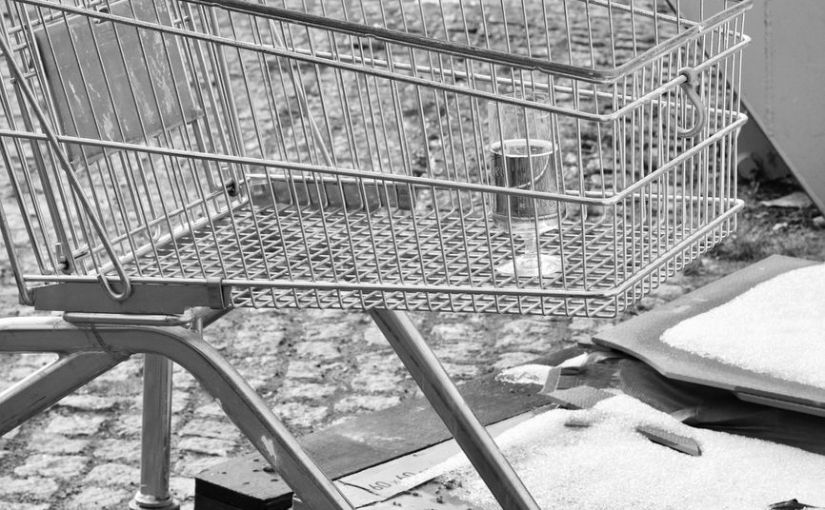
Every day, he would walk all over town dressed this way—miles and miles—pushing an old shopping cart full of rusty car parts and dented soda cans he’d collected from roadsides and weedy parking lots. At night, Crazy Ed would park his shopping cart outside the door to his apartment with a handmade sign on it: Do Not Touch. As far as I know, no one ever did.

Crazy Ed covered so much ground that you got used to seeing him. He was a fixture in town, so much so that his attire and shopping cart were in many ways just part of the fabric of the place, unremarkable in the way that familiar things tend to be regardless of their normalcy.

Although Crazy Ed wore a skirt and heels (I never saw him dressed any other way), he didn’t identify as female. He had a scraggly white beard and always wore a men’s shirt or sweater. During the colder months, he sometimes wore men’s athletic tube socks, the kind with the stripe at the top, with his high heel shoes.

Sometimes, kids would taunt Crazy Ed, especially young boys. Once, while walking to the corner store from my house, I came across a group of neighborhood boys throwing rocks at him. They were shouting homophobic slurs, and laughing whenever one of the rocks hit him. Unable to run in his heels, Crazy Ed took shelter behind his shopping cart. But the attack was so relentless that Crazy Ed was eventually forced to take his shoes off and hide. He cowered behind a parked car while the boys overturned his shopping cart and tossed his red heels into a nearby trashcan. 

At the time, I was nine years old. I felt so sad for Crazy Ed, and I was angry that the boys were given license to treat another human being so brutally, that they felt justified in doing so. Even at the time, I knew none of them would face consequences for what they had done. And none of them ever did. 

When I was in high school, I worked in a coffee shop downtown. Crazy Ed was one of our regular customers. Almost every day, he would park his shopping cart outside on the sidewalk, sit down at the counter, and order a black coffee, for which he would pay with a handful of grubby coins. He would often sit there for a half hour or more, keeping an eye on his cart through the window. He almost never talked, at least not any more than was necessary, unless someone spoke to him first.

Usually, other customers would just say hello to Crazy Ed, but if someone asked him a question, especially one about why he was wearing a skirt and heels, he would get angry and defensive, often causing a loud argument.

At the time, I found these exchanges, and Crazy Ed himself, pretty frustrating, especially considering the frequency with which they seemed to take place. The coffee shop was almost always busy, and it was easy to fall behind if something took your attention away from your work. The other employees and I eventually started trying to discourage Crazy Ed from sitting at the counter by putting his coffee in a to-go cup, but it usually didn’t work.

After I went away to college, I would still spot Crazy Ed around town sometimes when I was home on breaks, but not very often. A few months after I graduated, I moved to Boston to attend graduate school. After that, I don’t think I saw him again.

In the years since, I’ve often wondered what drove Crazy Ed to live the way he did. Did he suffer from some sort of mental illness or was he just eccentric? What was his life like before he moved into that basement apartment and took up roaming around town with a shopping cart full of junk? When and why did he start wearing a skirt and heels? Did he have a family? Did he have enough to eat? Why didn’t anyone ever try to help him?

When I think about Crazy Ed these days, it’s almost always with a wistful heart. Although I’m not particularly religious in a conventional Western sense, my memories of him often bring to mind the Parable of the Sheep and Goats in the Gospel of Matthew, which says the way we value and care for the most vulnerable among us—the poor, the hungry, the sick, those who are discriminated against for one reason or another—is, in the end, what reveals our true character.

ENP
The God of Doors

One of my late father-in-law’s favorite sayings was: There’s always the unexpected. No matter how carefully our plans are laid out, or how much we might want a particular thing to happen, or not, the possibility that something unforeseen will derail our wishes is ever-present. Most people, including me, find this fact unsettling. Knowing what’s likely to happen in a given situation is comforting, while change, even when expected, often provokes fear and uncertainty.
 
But change can also bring fortune to those who choose to embrace it. Losing a predictable but dead-end job creates an opportunity to land a better role at a different company, or perhaps to change careers or start a business. Ending an unhappy relationship with a spouse or partner makes it possible to start over again with someone new. 
 
Anyone familiar with tarot cards knows that the Death card, which depicts the Grim Reaper riding a horse over the deceased body of a king, rarely implies physical death. When this card shows up in a reading, it usually signifies a significant and often abrupt ending of some kind. This change will likely be difficult, but will hopefully foster the self-awareness needed to pull oneself together and start again, armed with wisdom gained from experience. The king on the card implies that no one is exempt from Death’s whims: It’s far better to roll with the punches and learn how to regroup than to wallow in self-pity.
 
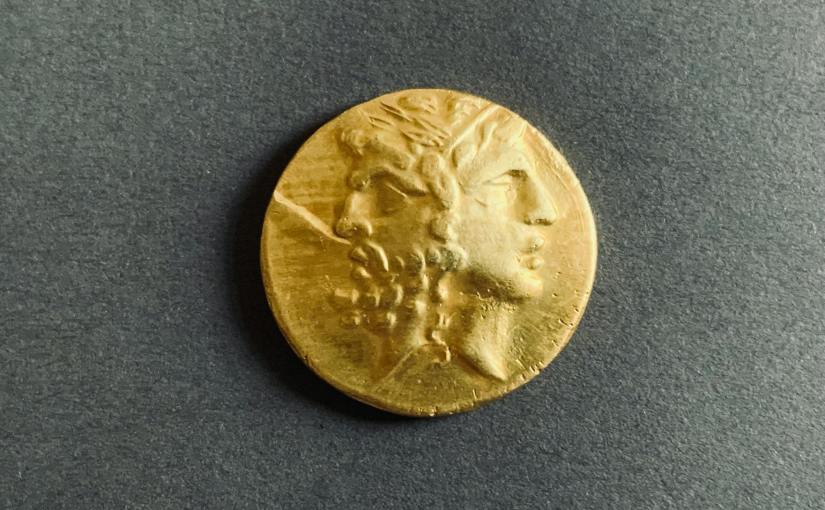
The ancient Roman god, Janus, has two faces. One looks forward into the future, the other, backward toward the past. He is the god of beginnings and endings, the god of change. Janus rules thresholds, gates, and doorways. He is present when someone is born, when someone dies, and during transitional events, such as weddings and graduations. The month of January is named for him.
 
Janus was the only Roman god without a Greek counterpart. And to the Romans, he was the most powerful god of all. He was fate’s doorkeeper, and they did everything in their power to gain his favor. On New Year’s Day, the Romans were careful not to say anything derogatory about another person. They offered sweets and gifts of coins to strangers, abstained from foul language, and performed good deeds in hope of creating conditions that would encourage luck and prosperity in the coming year.
 
Change has been rampant and unforgiving over the last several years. The COVID-19 pandemic was the most significant interrupter in modern times, upending jobs and marriages, travel plans, and the trajectory of nearly everyone’s lives. Currently, we in the United States are living with an unprecedented amount of uncertainty, never knowing what the fascist regime that controls our government will do from one day to the next, or how its whims will affect our lives.

In September 2020, my mother died after losing a short but brutal battle with lung cancer. In 2021, my adult daughter moved out of the house into a home of her own. Over a four-month period in 2022, I lost three of my close friends to cancer as well. My father-in-law died suddenly of heart failure in 2023.
 
These events have been heartbreaking and difficult, but most of them have led to positive new beginnings. After losing so many people to cancer, I have made it a priority to take better care of myself physically and mentally. I make time to do things I enjoy. I have been trying to socialize and travel more often, and have given up caring about anyone else’s opinions about what I do or don’t do. My relationship with my daughter has evolved and grown stronger, and after years of mourning my mother, my stepfather is now in a relationship with a wonderful woman who is a perfect fit for him.
 
We’re entering Janus’ season. In just a few short weeks, 2025 will be over. There’s no way of knowing what will happen in the year to come, but here’s to hoping the God of Doors will look upon all of us with kindness.

ENP

Summertime Magic

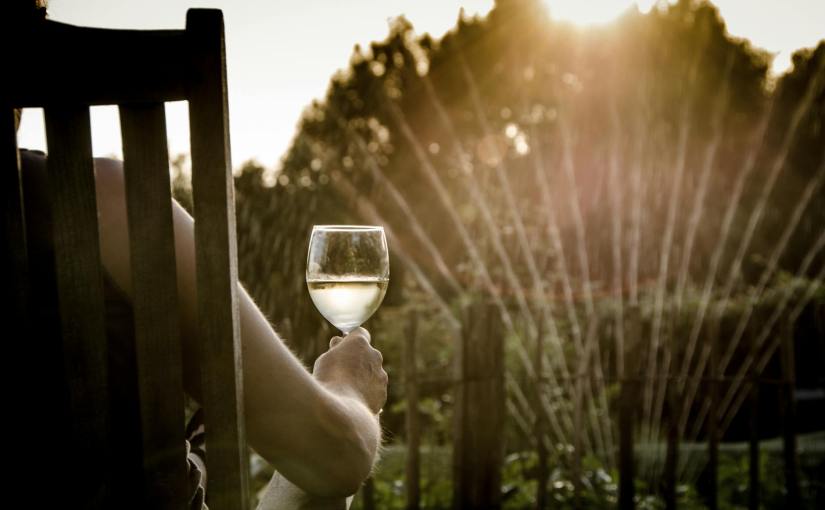
I still remember the satisfying feeling brought on by cleaning all the papers out of my desk and tossing them directly into the trash on the last day of school — no need to so much as glance at any of them. The day’s rising heat brought with it the promise of beach days, long, lazy afternoons punctuated by grape Popsicles, and running leaps through the backyard sprinkler. 

Summer meant visits from the neighborhood ice cream truck, rainbow-colored snow cones, and clusters of sweaty kids clutching damp dollar bills. My sister and I raced around the neighborhood on our bikes (no helmets! no shoes!), completely disregarded all advice regarding sunscreen, and stayed up well past our bedtime every night waiting for the sun to finally go down. Everything we did seemed to have an aura of magic to it.

I’ve spent a lot of time thinking about that magic and how I might try to recapture some of it.

When I was growing up, my friends and I were fully present during our summer vacations, no matter what we were doing. We weren’t thinking about all the chores we were supposed to do or that school was starting soon. Whether we were playing kickball with the neighborhood kids, making Italian ice runs to the corner store, or just hanging out on the porch trying to keep cool, that time was ours. We weren’t going to let anyone or anything take it away from us.

It’s rare these days to have any amount of time that’s truly our own. We’re accessible 24/7 on our phones. Our attention is constantly being drawn in ten directions at once by television monitors, emails, the daily news cycle. We’re always worried about the state of our country, the possibility of war, corrupt, evil politicians, the bills we have to pay, the kind of world we’ll leave behind for our kids.

All of those things are pressing, but they’re not going away, at least not anytime soon.

Summer is fleeting. It’s time we took all took a step back and carved out some time to enjoy the smell of freshly cut grass, the way the air smells when a sudden rainstorm hits the hot pavement. We can count the fireflies as they hover and flash on summer nights, and wake up early to hear the songs of morning birds.

We can dig holes in the sand and eat ice cream cones, read novels, stare at the sky, turn the music up loud in the car. We can do whatever we want if we let ourselves, even if it’s just for an hour or a lunch break or between phone calls. It doesn’t even need to cost anything.

The magic is still out there. Go and find it.

ENP

Redefining Success: Beyond Income and Wealth

In the contemporary United States, a person’s success is most often measured by their income.

While the size of someone’s paycheck often correlates with other types of achievement, such as educational attainment, it says nothing about a person’s character or whether the things they do on a regular basis have the potential to improve lives or make the world a safer, healthier, more beautiful, or more just place.

Income on its own says nothing about a person’s happiness. It cannot tell us whether someone looks forward to getting up in the morning or whether they face each day with a measure of dread. The size of one’s bank account does not indicate whether its owner is living in a way that supports his or her values, interests, talents, and wellbeing, whether they are able to do the things they enjoy, or how their lifestyle affects their interpersonal relationships, the environment, or their community as a whole.

Money is necessary to pay for our housing and necessities, to take care of our loved ones, and to do many of the things we enjoy. But after these requirements are comfortably met, is accumulating more wealth worthwhile if it means sacrifcing happiness and meaning in our lives?

Most of the successful people I know are not rich. They don’t own BMWs, yachts, or vacation homes, but neither are they starving. They are nurses, musicians, teachers, firefighters, artists, farmers, photographers, tour guides, chefs, artisans, plumbers, winemakers, carpenters, and writers who wake up every morning enthusiastic to start their days because they get to do something they enjoy, because their work carries meaning and value that surpasses its assessed economic worth. 

Truly successful people nurture their relationships. They have the time and energy to pursue their hobbies and interests, to learn new skills, to visit new places and discover things about the world and themselves. They make time to watch sunsets. They appreciate the beauty in simplicity. Successful people are happy much of the time because they are rewarded by things that are not, and never will be, for sale.

Real success lies somewhere between presence and productivity, security and curiosity. It deflects judgement. To be successful is to continually improve upon one’s knowledge and understanding of the world. Successful people aren’t afraid of hard work. They take pride in the things they do and make, and ask for advice when they need it. They care about the legacies they leave behind.

No one is getting out of here alive. Whether or not their efforts lead to financial gain, those who use their time on this planet wisely, who understand that wealth and achievement are not necessarily one in the same, will always be the most successful.

ENP

Crossroads

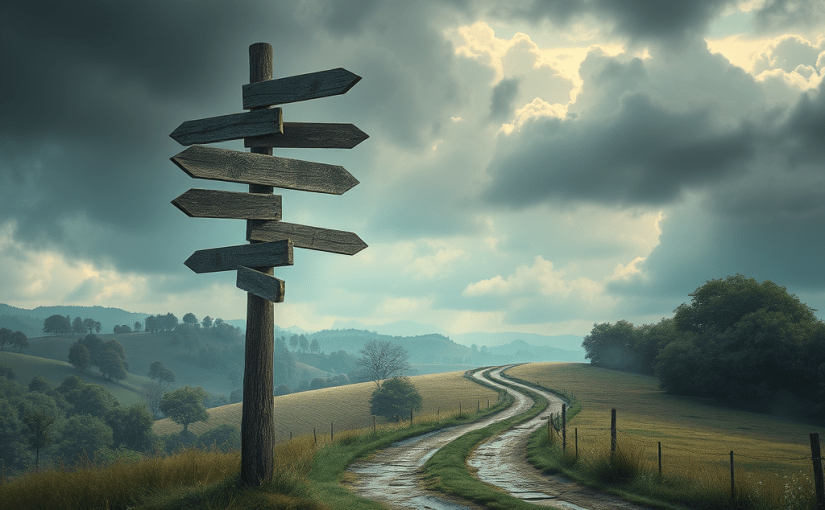
The beginning of 2025 finds my life at a crossroads. I’m very close to finishing my third novel, a project on which I’ve been working for years and desperately want to complete. At the same time, I seem unable to focus on it. My husband was laid off from his job at the end of September, leaving us adrift in a gulf of uncertainty.

Do I sequester myself in some quiet place where I won’t be distracted for a couple of weeks to finish my book? Should I put the book aside for the time being and look for steady nine-to-five work? Or should I try to find more freelance jobs so I can have a flexible schedule and make more money at the same time, allowing me to still work on the novel? If I do this, will I be too tired to work on the book anyway?

Perhaps I should try to bushwhack my own path, combining these options in such a way that I’ll be able to accomplish most of what I want?

I’ve been stuck, waiting for a sign, for some sort of messenger to point the way, getting nothing done in the meantime.

In Western folklore, crossroads often symbolize liminal spaces, places between worlds, middle passages that are neither in one realm nor another. In medieval Europe, the bodies of executed criminals and people who had committed suicide were often buried at crossroads as they were considered a sort of no man’s land, places set apart from the world from which the souls of the dead would be unable to escape.

Lacking a map or any sense of direction, I’ve discovered that exiting a crossroads, where no path is clearly defined, can be almost as difficult for the living.

In many cultures, crossroads are places where demons and spirits appear unexpectedly. In the early 20th century American South, many African Americans believed visiting a crossroads at certain times of day meant encountering the Devil. It brings to mind the frequently covered song, Cross Road Blues, by blues guitar pioneer Robert Johnson, originally released in 1937. According to legend, Johnson, who died mysteriously at age 27, acquired his impressive musical skills after selling his soul to the Devil at a crossroads.

Robert Frost’s famous poem The Road Not Taken, published in 1916, also comes to mind, as crossroads often symbolize indecision, uncertainty, or even regret in literature.

But crossroads can also be places of opportunity. By their nature, they are places where chance meetings are likely to occur, perhaps allowing favorable circumstances to unexpectedly manifest themselves.

Modern psychology says when we find ourselves at a crossroads, unable to decide which direction to take, it often means we are preparing to let go of something to which we are emotionally attached. I often feel this way lately. Whichever direction I choose to go, I’ll be leaving something behind. And because whatever I stand to potentially gain remains undefined, the risk involved in taking any one road seems great.

Robert Frost felt called to take the road “less traveled by,” knowing he’d probably never learn what he might have discovered had he chosen the other path. One of these days, the voice of wisdom will prevail and I’ll know what I should do, too. In the meantime, I’ll be keeping an eye out for the Devil.

ENP