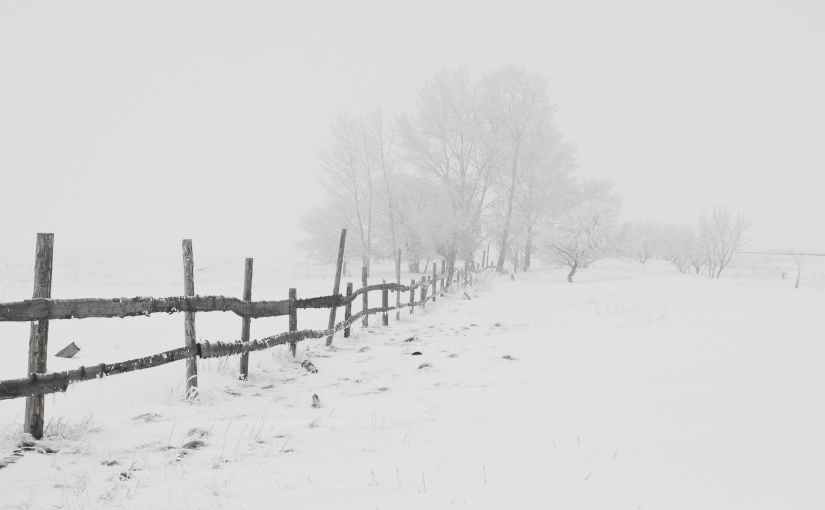
Winter

I’ve never been one of those people who dislikes winter. I don’t really mind the cold, and I love snowshoeing and cross-country skiing, even though I’m pretty bad at the latter. There’s something invigorating about being out in the woods in the cold air. I love seeing animal tracks and deer beds, and tiny red-breasted nuthatches and chickadees eating the seeds from pine cones. There are usually very few other people around. It’s peaceful. It helps me get my thoughts in order.

So far, this winter has been tough, though. Even though we’ve had a lot of snow, it’s been too dangerously cold and windy in the mountains to spend any time up there. Even getting out in our local forests hasn’t been easy because of the weather. And I’ve been sick. Since the end of January, I’ve had some kind of awful virus that just won’t quit. It’s wearing on me, and it’s making it difficult to get anything done. I’m getting better, at least I think so. It’s just not happening quickly.

I’ve decided to take next week off to finally goddamn finish my third novel and get it off to beta readers. It’s so close to being done. I’ll work twelve hours a day if I have to in order to get it finished by the end of the month. At this point, it’s the best I can do to try to redeem at least part of the winter.

ENP

Stick Season

Up in the White Mountains, locals call this time of year “stick season.” As you might guess, the name comes from the deciduous trees, now bare after a brief few weeks of showing off their colorful foliage. From a distance, the green of the conifer trees growing on the mountainsides—spruce, balsam, hemlock, and white pine—stands out among the patches of gray created by the stands of naked maple and beech trees. Golden tamaracks, the only deciduous conifer trees I know of, can occasionally be spotted among the swaths of green as they prepare to shed their needles for the winter.

Stick season is my favorite time of year in the mountains. Blocked by foliage during the summer, the views stretch far and wide. In spite of sunset coming earlier, the forest is brighter. There’s no snow yet, at least not much, so the ski areas are still closed. Traffic, even on weekends, is at a minimum. Hotel rooms are cheap and plentiful. Parking at trailheads is almost always open.

The best thing about stick season is the quiet. I can hike in the still forest and listen to the calls of boreal chickadees and imagine the mountains as they were before people flocked to them. Occasionally, I cross paths with another person on the trail who, like me, can see beauty in places where many others don’t. We nod and say hello, fellow travelers among the sticks.

ENP

*NO AI TRAINING

The Chairs of Summer

Over the past few years, my husband and I have spent several weekends at the Eagle Mountain House in Jackson, New Hampshire. We began staying at the hotel because it’s close to many of the places we like to go hiking. One of the best things about the hotel, built in 1879, is its enormous wrap-around front porch lined with wooden rocking chairs.

As we sipped coffee on the hotel’s porch on a recent Sunday morning, I started thinking about these chairs: the generations of summer visitors who have sat in them; the conversations they’ve had; the marriage proposals; the breaking of bad news; the cocktails people have enjoyed while taking in the mountain views.

Eagle Mountain’s sturdy rockers reminded me of similar ones on the porch of the historic Gosport Hotel on Star Island, located off the coast of Portsmouth, New Hampshire. I spent several summers hanging out in these chairs growing up. As much as my life changed over those years, the chairs, solid and hard-worn, were always the same.

At the house where I lived as a kid, we had a set of heavy wooden outdoor chairs with removable vinyl cushions. Hand-me-downs from a family member who no longer wanted them, these chairs were monstrosities. It took two adults to move one. The cushions soaked up rainwater like sponges, and if you happened to stub a toe on one of the chairs’ legs, you’d be hopping around for ten minutes, howling. When my friends came over, we usually sat on the lawn.

The first summer I lived on my own, after graduating from college, I bought two green plastic chairs at a hardware store. I lived in Boston and didn’t have a car, so I carried them the three blocks back to my apartment. My roommate and I put the chairs out on our miniature back porch, which overlooked the kitchen of a Chinese restaurant. We spent much of that summer sitting in them while grilling burgers on our rickety hibachi and drinking gin and tonics out of plastic cups.

My husband bought me a foldable canvas sand chair with the Rolling Rock beer logo on it—a promotional item he’d found at a liquor store—when I was pregnant with our daughter. It’s one of the most comfortable beach chairs I’ve owned, but as that summer wore on and my belly grew bigger, I frequently needed his help to get out of it and back into a standing position.

When our daughter was a toddler, we got her a pint-size white resin chair, just the right size for a two-year-old. She used to like to sit outside in it to eat lunch, a 5-gallon bucket serving as her dining table. We were living in our first house at the time. When we sold it we got rid of most of our outdoor furniture, but not that chair. She’ll be 25 this year, and that little seat is still stored up in the rafters of our garage.

For a number of summers, my husband complained about the fact that it’s nearly impossible to find the old fashioned aluminum-frame chairs—the foldable kind with backs and seats woven from vinyl straps—that his parents had when he was growing up. Several years ago, quite by accident, my daughter and I found these chairs for sale at a discount store, and bought one for him for Father’s Day. As a surprise, we put a fancy bow on the chair and set it up in the middle of the garage so he’d find it when he took the trash out. Its metal frame digs into the back of your legs after you’ve been sitting in it for a while, but it’s still the only chair he uses whenever we host a barbecue.

We’ve wiled away many pleasant summer afternoons in the four red plastic Adirondack chairs we bought when we moved into the house where we live now. But they only seem to last a season or two before they have to be replaced. We’re down to two of these chairs now—both sure to break soon. We’re not home a lot on weekends anymore, so we still haven’t decided what to replace them with.

Weighing a mere two pounds each and folding neatly into custom carrying cases, our newest summer chairs are stored in the back of our car. Made of polyester mesh and steel, these two comfy high-tech seats are ideal for relaxing and enjoying drinks and snacks after a long hike. They weren’t inexpensive, but they were worth every penny.

Note: A version of this essay appeared in the July/August 2021 issue of Merrimack Valley Magazine.

ENP

*NO AI TRAINING

Curveballs

Like most responsible adults, my husband and work all week, pay our bills on time, and strive to take good take care of our family, pets, car, and house. Although we’re often busy, we’re lucky to have a good life (knock on wood). I’m grateful for everything we have and for all the things we’ve accomplished.

I’m not the type of person who usually complains, but the past couple of months have felt like one long workweek. It’s been nearly impossible for us to get a break from our responsibilities, even on weekends.

Dating back to the middle of February, every time my husband and I made plans to do something we wanted to do, something else would come up, giving us no choice but to cancel and deal with whatever issue had reared its head.

It started with our bathroom renovation. Our contractors wanted to work on weekends in order to get the job done faster. This isn’t a bad thing, but it wasn’t something we’d anticipated. In order to be home we had to cancel hiking trips we had planned two weeks in a row.

Soon after that, our adult daughter, who is in her early 20s, came home one afternoon and announced that she’d just bought a condo. We were very happy for her, and proud that she’d done it all on her own. Instead of cross country skiing, we spent the following weekend helping her pack up her belongings. The weekend after that, we had planned to snowshoe in the White Mountains. We traded our snowshoes for a rented van and helped her move everything into to her new place.

The weekend after our daughter moved, we had to do our taxes. Because I’m a self-employed writer, this is always an arduous, stressful chore, even with the help of expensive software. Happily, we discovered that we were getting a refund.

We booked a weekend getaway for early April to celebrate our wedding anniversary.

A few days before our trip, a close friend of ours died unexpectedly. Her funeral was planned for the following Saturday. I called the hotel where we had made reservations and asked if we could move our stay up a week. The person I spoke to said we could, but the nightly rate would be more than triple the amount we had originally booked due to it being school vacation week. I cancelled the reservation.

With the exception of 2020, we’ve hosted Easter dinner at our house every year for nearly two decades. We spent the Friday and Saturday before Easter shopping, cleaning the house, planting flowers, coloring eggs, cooking, and driving around to various stores looking for sidewalk chalk to entertain our boredom-prone younger guests.

The day after Easter, I cleaned the house again in between replying to work emails and running errands I didn’t get to on the weekend.

Beginning this Thursday, we have a reservation at a condominium in the Berkshires for four nights. We plan to hike Mount Greylock and the Ice Glen. Maybe we’ll go out for dinner, and cook brunch one day after sleeping in. We might wander around Stockbridge, or visit one of the area’s great museums. And if someone calls, I won’t be answering my phone.

ENP

Moving Mountains


Women who are strong and brave enough to challenge convention have always fascinated me. Whatever their motivation in refusing to adhere to the status quo, women like Marie Curie, Susan B. Anthony, Amelia Earhart, Julia Child and Dr. Jane Cooke Wright, an African American physician who was among the scientists to pioneer chemotherapy as a treatment for cancer, all helped change the world and the way the world views women.

In honor of March being Women’s History Month and because I love hiking and mountains I wanted to write a post about one of my favorite female pioneers, Miriam O’Brien Underhill.

A New England native, Miriam was born in Lisbon, New Hampshire, in July 1898 and grew up in Dedham, Massachusetts, just south of Boston. At a time when few women attended college, she earned a bachelor’s degree in mathematics and physics from Bryn Mawr College in Pennsylvania in 1920. She completed graduate work in physics at Johns Hopkins University in Maryland in 1925. After leaving Johns Hopkins, Miriam began a career in medical research at Massachusetts Eye and Ear Infirmary in Boston.

As impressive as this is, it’s not what Miriam is known for. Although she died in 1976, Miriam O’Brien Underhill is still considered by many to be one of the most gifted mountaineers of all time.

Most of Miriam’s early climbs were in the Alps, where she was among the first group of people to climb several challenging peaks beginning in 1926. These include the 11,184-foot Aiguille de Roc in Chamonix, France, and the triple-peaked Torre Grande in the Italian Dolomites, where the route she climbed is named Via Miriam in her honor. She is perhaps best known, though, for being the first woman to climb mountains “manless.”

After several years of climbing with male friends and guides, Miriam decided that in order to truly develop her skills as a climber and leader she would have to undertake some difficult ascents without any men present. She did this beginning in 1929, when she traversed the double peaks of the Aiguille du Grepon in Chamonix with French climber and friend Alice Damesme. Miriam’s other female-only climbs would include the Monch and Jungfrau in the Swiss Alps in 1931, and the 14,692 ft. Matterhorn in the Swiss and Italian Alps in 1932.

In 1933, Miriam married fellow mountaineer and Harvard University professor Robert L.M. Underhill, who became her climbing partner for the rest of her life. They raised two sons, Robert and Brian, born in 1936 and 1939, and made several more first ascents, this time of mountains in the American West, including peaks in Idaho’s Sawtooth Range and Montana’s Mission, Beartooth and Swan ranges. Most of these climbs were made without the aid of cut trails, maps, or guides, as there were none.

In addition to climbing, Miriam was also a prolific writer and talented photographer, contributing several articles to National Geographic magazine and serving as editor of Appalachia, the journal of the Appalachian Mountain Club (AMC), for six years. Her autobiography, Give Me the Hills, was published in London in 1956 by Methuen & Co. Publishing, and was released in the U.S. by The Chatham Press in 1971.

A scientist by training, Miriam never lost her curiosity. During her climbs, she discovered numerous new species of alpine wildflowers. Several of her photographs illustrate the AMC Field Guide to Mountain Flowers of New England, published by the AMC in 1964.

When Robert Underhill retired, he and Miriam moved to Randolph, New Hampshire, where they were among the first people to climb all of the White Mountains’ 4,000-footers (46 of them were known at the time). They helped establish the AMC’s Four Thousand Footer Club after reading a 1931 Appalachia article by Dartmouth College librarian Nathaniel Goodrich, who described a similar practice by European climbers in the Alps.

When Robert was in his early 70s and Miriam in her early 60s, they became the first people to climb all of New Hampshire’s 4,000-footers during the winter, an undertaking that Miriam felt was more “sporting” than climbing them in the summertime due to freezing temperatures and deep snow.

During the late 1950s, when they were making their winter climbs, few roads in the White Mountains were plowed, adding many additional miles to their hikes and often requiring the couple to camp overnight. The Underhills completed the winter 4,000-footers on Mount Jefferson on Dec. 31, 1960. The temperature was minus 18 F and the wind speed was 72 mph.

The next time you’re out on the trail, raise your water bottle in a toast to Miriam.

ENP

Note: A version of this essay appeared in the March/April 2021 issue of Merrimack Valley Magazine.

Every Idle Hour

My mother took every opportunity she could to complain about winter. She hated the cold, snow, and the short days we experience here in New England so much that her negativity spilled over into autumn. She could never understand why anyone would get excited about the foliage changing from green to red or would look forward to a crackling fire on a fall evening when these things meant ice and darkness were lurking around the corner.

I’ve always liked winter, though. During the rest of the year, I often long for the stillness the season brings. I love staring out the picture window in our living room when it snows, watching the swirling white flakes pile up and form drifts in the wind.

I never learned how to ski and I’m a subpar ice skater, but my husband and I hike frequently in the wintertime. The first time I remember experiencing complete silence was a few years ago, on a trail coming off of Hedgehog Mountain in New Hampshire. We paused to look at some animal tracks and when the crunching of our snowshoes stopped, we heard nothing but the sound of our own breathing: no cars, no airplanes, no people, no wind. It was one of the best moments of my life.

Nothing makes me feel more alive than the cold air on my face while I’m walking among the bare bones of the trees. I love cuddling up to my husband between our fluffy flannel sheets, cozy and warm as the temperature drops below zero outside. Rarely do I feel more privileged than when I’m the first being to make tracks across a snow-covered landscape. I like wearing sweaters and knit hats and wool long underwear. Few things are more spectacular than the pink-and-orange glow of a winter sunset.

Winter allows me the space and time to think, work, rest, and recharge. As the snow falls, I’m working to finish two book manuscripts that have been sitting on my hard drive since before the COVID-19 pandemic started, when concentrating on anything became nearly impossible.

If you’re anything like my mother, don’t let the cold get you down. If you let it, this enchanted season can warm your heart and bones.

ENP

NOTE: If you were a fan of my Living Madly column in Merrimack Valley Magazine, which ceased publication as of December 2021, you’ll be happy to know that I’ll still be writing the column. Beginning on January 20, 2022, Living Madly will be published the third Thursday of each month on RichardHowe.com.

Kill Your Bucket List

American jazz musician and composer, Miles Davis, once said, “Time isn’t the main thing. It’s the only thing.” In a world where many people can’t afford to feed their kids, statements like this used to make my eyes roll. But as I’ve gotten older, I’ve come to agree with him.

Over the past couple of months, two close friends of mine from college have been diagnosed with cancer. Neither of their prognoses are good. Because the three of us are the same age, I’ve been thinking a lot about the things I still want to accomplish in my life, as well as about the ways in which I spend my time.

Like many people, for most of my adult life I’ve had a “bucket list” mentality. That is the tendency to divide the things I need or want to do into two categories: “things I have to get done now” and “things I plan to do at some later time.” The former category usually includes tasks like writing magazine articles, grocery shopping, and folding the laundry, while the second encompasses activities like hiking in Scotland, reading the stack of novels on my bedside table, visiting old friends, and finally finishing the three book manuscripts currently living on my hard drive.

I never saw a problem with this until recently. When, after all, is “later?” And what would I have to show for myself, and my life, if I were suddenly diagnosed with a terminal illness, unable to walk or talk or write another word? The answer, of course, is not the one I want.

The good news is that I still have time (knock on wood). I’m in the process of trying to figure out what work I can afford to turn down, and what household chores I can put off or delegate in order to make my bucket list my to-do list.

I don’t think it will be easy. It’s difficult to break old habits. And it’s even harder to ignore the voice in my head that tells me I’m being irresponsible if I choose to hike up a mountain instead of mowing the lawn.

Miles Davis died suddenly at the age of 65. It’s something that happens all the time. On an intellectual level, we know we are finite. But ours is a culture that eschews talking or even thinking about death. I think we need to start, though. Admitting to ourselves that we won’t be here forever, on a daily basis if necessary, is the best way I can think of to get the really important stuff done.

ENP