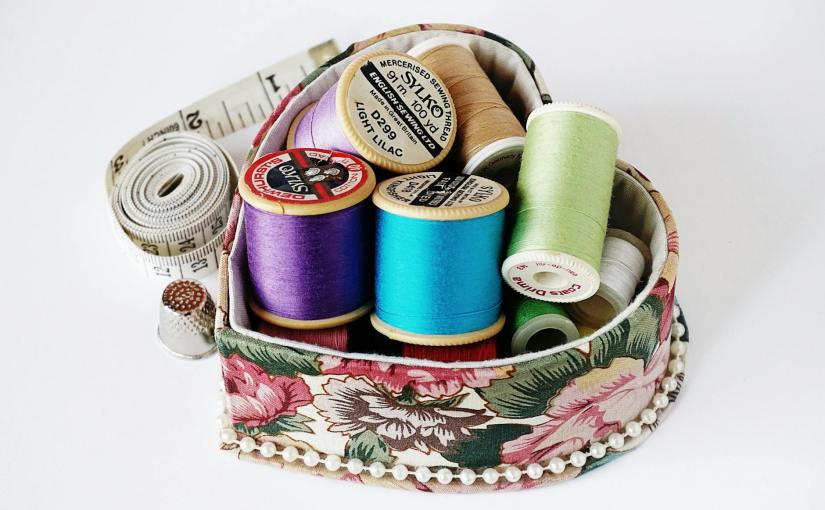
My maternal grandmother had a sewing room in her house that she jokingly referred to as her “sweatshop.” Once a spare bedroom, the space was home to her two sewing machines and hundreds of yards of fabric of all types and colors. Throughout her life, she made most of her own clothes, often from patterns she designed. This included complex garments like bathing suits, which she was famous for being able to whip up in just a couple of hours.
If you got a hole in your sweater, my grandmother, also a master knitter, could fix it for you, flawlessly matching the stitch pattern. When you got your sweater back, it was usually impossible to tell where the hole had been.
When my sister and I were in elementary school, my mother sewed all our Halloween costumes. We got to trick-or-treat in sequined ball gowns and flowing black witches’ robes while the other kids in our neighborhood were stuck wearing the flimsy plastic costumes they sold at Woolworth’s.
My mother had a studio on the lower level of her house. The room was home to several sewing machines, a work table, plastic storage bins full of fabric, dozens of shades of yarn, water color and calligraphy supplies, embroidery hoops and floss, quilting tools, glass jars full of buttons, and a shelf crammed with books containing the instructions to make just about anything, from decorative paper cuttings to macramé bracelets.
She taught my sister and me how to use a sewing machine and make simple items like pillow covers when we were kids, but I was never really interested in sewing until I was in college. My senior year, I bought my own sewing machine, a major expense at the time.
I sewed a lot when I was in my twenties. Having this skill made it possible for me to make clothes for myself and things for my home, like curtains, that I couldn’t have afforded to buy. More recently, I’ve come to love cross stitch embroidery, and for the last couple of years I have crocheted almost every day.
Like many other types of handiwork, crocheting is fun, relaxing, and a good creative outlet. It’s helpful for relieving stress and anxiety, and I end up with a lot of hats, blankets, sweaters, bags, and scarves that I can give to people I love and donate to charities.
Although traditional women’s handicrafts like sewing and knitting have in recent years been co-opted by members of the right-wing “Christian” movement in the U.S., particularly in relation to its misogynist tradwife trend, it’s important to keep in mind that women’s traditional work has provided families with essentials like clothing and textiles for much of human history.
These domestic arts have also provided women with a way to earn an income and gain independence when few other options for employment were available to them— something that was true until relatively recently in the West and that continues to be the case in other parts of the world.
Crafts like sewing and weaving have throughout history served to give women agency, amplifying their voices at times when their opinions, ideas, and even their value as human beings have been viewed as marginal at best.
Examples of this can be found everywhere, from the suffragettes who used embroidered handkerchiefs to communicate with one another in the 19th and early 20th centuries, to the pussyhat-wearing political protesters of early 2017, to women living in modern day India and Nepal whose handmade pottery, jewelry, and clothing, sold through organizations like UNICEF, have given them the financial means to escape abusive marriages, prostitution, and forced sweatshop labor.
It’s even seen in literature. In the Pulitzer Prize-winning novel, The Color Purple, Alice Walker’s downtrodden protagonist, Celie—brutally raped, beaten, and abused by the men in her life since childhood—finds freedom and financial independence when she starts a business sewing pants for other women—a still-radical female wardrobe choice in the 1930s, when the novel was set, and one that clearly challenges the authority of traditional pants-wearers.
In recent years, perhaps as a backlash against mass production, throw-away culture, and the virtualization of our everyday lives, many younger women (and men) are now learning to knit, crochet, spin, and sew. Big box retailers like Target now sell yarn. Both large, mainstream online platforms like YouTube and TikTok and smaller, independent ones like Purl Soho and KnittingHelp offer dozens of videos to help people learn traditional handicrafts. And in-person classes and workshops can be found at libraries, cafes, and community centers across the country.
Traditional women’s handicrafts might just be one of the things that saves us from the mess we’ve gotten ourselves into, and in some ways, at least to me, that seems appropriate.
ENP

 Emilie-Noelle Provost
Holy cats, your grandmother was impressive! As a homebody, I, too, have come to resent how tradwives have sullied the homely arts. Darn them!
LikeLike